Richard Hanania, the once covert and then not-so-covert white supremacist and Trump-supporting intellectual, has been on an apology tour since 2023, though he only abandoned his support for Donald Trump in 2025. One problem with that is that it’s not all that clear what he’s sorry for, outside of not being allowed to the right dinner parties and later being had by Donald Trump on tariffs.
Here’s Hanania’s mea culpa in his own words:
The revelation of my anonymous writing clears up what someconsider a mystery, which is why such a large portion of my current work involves attacking right-wing collectivism and illiberal beliefs (seehere andhere). The truth is that part of it is self-loathing towards my previous life. I all too clearly notice the kind of sloppy thinking, emotional immaturity, and moral shortcomings that can lead one to adopt a quasi-fascist ideology, and am hard on others because I’m hard on myself for once holding such views.
[…]
As far as my intellectual journey, I’ve come to firmly believe in classical liberalism, due to a process of elimination as much as anything else. Since I’ve started paying attention to politics, we’ve seen Iraq, the financial crisis, the rise and fall of ISIS, the continuing growth of China, the increasing relevance of social media, the Great Awokening, the Trump movement, covid-19, and now the Ukraine War. Having gone through all that turmoil, America’s economy remains strong, and for all our problems, each of the potential alternatives from Chinese technocracy to Islamist theocracy to Putinism has to be considered an utter failure.
Despite being a believer in second chances, I do not find this persuasive. As I’ll explore, Hanania seems perfectly committed to a lot of illiberal thinking, not least on gender issues. But the other problem here is that this seems to be working—at least a little. Hanania has been treated to a profile in The Atlantic, continued opportunities to publish in places like the Boston Globe and Houston Chronicle, and offered interviews by places like Vox. The Atlantic piece was noteworthy in that it presented Hanania as a rogue and compelling thinker on the problems of populist politics, even if he’s likely not as reformed a thinker as he claims.
Hanania still admits to being right-wing in many ways. And he retains right-wing preoccupations like birth rates, as well as a firm belief in hierarchy and the beneficial role of elites. Yet he is clearly also a creature of right-wing pathologies.
But rather than applying a more generalized theory, like the excellent ones offered here by Cameron Cummins-Smith or here by Samantha Hancox-Li, we can use Hanania as an individual case. I am far from the only person dubious about Hanaia’s new role as a former racist. This August, Christopher Matthias criticized The Atlantic’s profile for letting Hanania off the hook too easily, writing at The Handbasket that “I promise you that [Hanania] does not have a point. His screeching about ‘Elite Human Capital’ is just a not-so-slick recapitulation of the vile eugenicist worldview he espoused as ‘Richard Hoste’ over a decade ago.” That warning is clear enough, and it should be heeded.
Hanania is an early case of the type we will likely face in much greater numbers after Trump is gone. That is, some chunk of the far-right commentariat will try to make safe passage back to mainstream media. We should not let them. But I don’t think this is sufficient analysis of Hanania’s case or the things it has to teach us in this moment.
I want to push past Hanania’s no-longer-a-racist redemption tour because I think that has been adequately discredited. Rather, I will add here that it’s interesting to me what aspects of his image Hanania is interested in curating for his audience. I suppose it’s a net positive for racists to feel they must pretend to be otherwise in order to ingratiate themselves with mainstream elites.
What astonishes me in the public treatment of Hanania is how little attention is paid to his inveterate male supremacism. On this front, he has not attempted even a quick costume change. Instead, Hanania is quite simply a rape apologist. His approach to women’s sexuality is that it exists to serve men, both through sexual reproduction and through the maintenance of long-standing misogynist ideas about when and how women can consent to sexual intercourse.
This manifests in Hanania’s contempt for victims of rape and trafficking and his repeated support for age-gap relationships, even those that would constitute statutory rape in many jurisdictions. When The Bulwark broke news on Monday that Gen-Z looksmaxxing influencer Clavicular had been accused of rape, Hanania sprung into action discrediting the allegations. On X, he posted,
Women who claim to be sexually assaulted or raped and then continue associating with their alleged attackers deserve zero sympathy.
They're either
1) liars; or
2) making it impossible to differentiate between real and fake allegations, hurting other men and women and society as a whole
A sane legal system would take this into account and not trust such women in criminal or civil lawsuits. They should also be socially stigmatized as bad people.
Hanania then wrote a post on his Substack. Here, he detailed further why he sees women who keep in touch with their abusers as inherently unbelievable—this, despite a wealth of evidence that victims of assault and abuse frequently maintain contact with their abusers. The reasons are complex and varied, but it is a wholesale lie for Hanania to claim such behavior makes accusers less credible. And it’s a lie in service of a simpler, darker worldview. Hanania clearly sees rape, physical and statutory, as the right and prerogative of men. This is especially true of rich, successful, or powerful men—in other words, elites.
Take his repeated apologia for statutory rape. Hanania doesn’t even pretend to make this about some sort of free-love egalitarianism. Instead, he argues strictly from the point of view of implicitly older men who want to sleep with girls. Allow me, if you can stomach it, to quote him at length:
There is no way to call attraction to 17-year-olds pedophilia without also stigmatizing attraction to women who are slightly older than that. We have an age of consent, and it used to be recognized that it was an arbitrary line that we have to set somewhere. But before the last decade or two, there wasn’t this idea that men whose sexual preferences did not exactly line up with the legal minimum in the jurisdiction that they happen to live in were disordered or somehow abnormal. This is a bizarre idea that is frankly inconsistent with people being able to develop realistic understandings of sex differences and human biology.
If men who are attracted to 17-year-olds are disordered, on what basis can those who like 20-year-olds be considered normal? I’ve noticed that most of the women who are mad at age gap relationships are aggressive middle age types who seem to have a deep personal interest in the issue.
It’s no mistake that this is all entangled with Hanania’s horrific defenses of Jeffrey Epstein and the abuses on his private island. Hanania has posted that “Hating Epstein represents the essence of antisemitism. The resentment of mediocrities, conspiracy thinking, and chud moralism.” He went so far as to baldly assert that some of the women not only had it coming but even benefited in the end from Epstein’s systemic rape operation:
One of the Epstein "trafficking victims" is a prostitute who he met when she was in her twenties, who had sex with him and reported that he gave her an orgasm.
There's more evidence of Epstein being a stud than there is he's what conspiracy theorists claim.
Hanania made these arguments in 2026, three years after he supposedly stopped sucking and adopted classical liberalism. His language here is saturated in male supremacy, treating women as little more than pleasure machines and objects of male desire. But it also does something else that is less often noticed within male supremacist thinking and is key to Hanania’s political philosophy. It places some men above others in a hierarchy whereby they have the best and most access to a population of submission and coyly desirous women (or rather, girls).
Another male supremacist, Pete Hegseth’s supreme man, is the sinewy, hairless extra from Zack Snyder’s 300 he sees as the ideal American soldier. But Hanania’s is different. It’s a Revenge of the Nerds form of male supremacy wherein the elitism is derived from wealth, intelligence, and the intellectual brio to defy “chud moralism.”
So when we confront Hanania’s efforts and successes at breaking through as a mainstream thinker, we have to reckon with not only the racism he seeks to obscure but the virulent male supremacist he’s made no effort to hide or soften. That any in our media are willing to look past or caveat these views is a warning sign about the sickly condition of our civic morality. And it’s a blaring warning sign about who and what might be allowed to direct our national conversations even after Trump is gone.
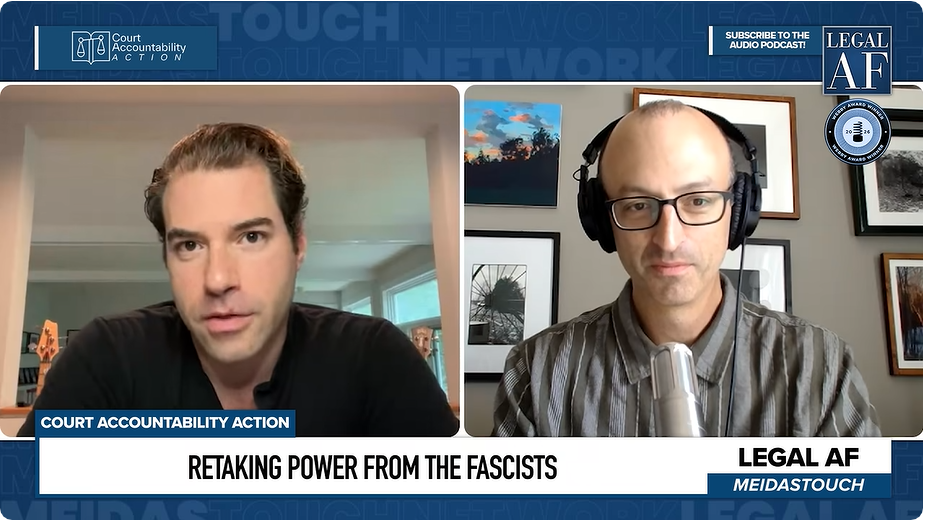
This week I went on Legal AF, a show on the MeidasTouch network, to talk with Mike Sacks of Court Accountability Action (CAA) about The Reconstruction Papers.
As a reminder, you can get your own copy of The Reconstruction Papers and reserve a copy of next year's issue for just $60 right now:
Free and open public spheres are always unpleasant, frequently abusive, and chock-full of all sorts of lies, conspiracy theories, and nonsense. What the Internet has done is lowered the barriers to entry to the ground, and perhaps lower—it is not just that it is easier to publish online, but we are expected to have some kind of online presence, just as a matter of norms and facilitating social coordination. It is possible to be almost entirely offline, other than an email address and phone number through which one can be messaged—but doing so carries the risk that you will miss out on opportunities in your daily life.
In short, nearly everyone is online now, to some degree. And to be online means that you have, at your disposal, the equivalent of both a printing press and international distribution syndicate at your fingertips. Like the old press, having those things does not guarantee you an audience; and indeed, precisely because these things are available to everyone, the competition for audiences is more fierce than it has ever been. Your odds of casually taking an audience for yourself are quite low.
Individual odds aside, in aggregate this does mean that new “presses” are popping up all the time. And given such presses begin their existence as the product of amateurs, they lack the kinds of norms and ethics that might constrain a buttoned up, professionalized operation. The modal new media “influencer” therefore has much more in common with tabloids than with the New York Times of any era.
Those disenchanted with our era of the democratized tabloid often take refuge in nostalgia. In America, this means looking back to the era of the Big Three broadcasters (NBC, CBS, ABC), with its higher standards and the greater unity it was able to produce in national culture. If only we could somehow recapture the essentials of that moment. Those inclined to do more than fantasize about the past suggest building up the current public broadcast model, or adopting models found elsewhere—the BBC approach, for example. Perhaps, through government policy, we can overcome the technological sinkhole of our media moment and return big, consolidated broadcast to its rightful position of primacy.
But even in the heyday of the Big Three broadcasters, in which the austere heights of broadcast culture were gatekept by white men in suits, the riot of print culture continued unabated: messy, unpleasant, full of inaccuracies and outright lies, and with a large tabloid component.
To be a liberal is to affirm that the cost of a free press is well worth the price of admission. But we must admit that there is, indeed, a price. Nostalgia for an era that, in point of fact, was just as terrible as our own and worse in several important respects cannot serve as a guide for the present or future.
Like everything in a dynamic, creative, and pluralist society, freedom of speech and of the press have always threatened to blow the whole thing up, to be so out of control as to derail their own foundations. Time and again, dictators have arisen from that chaos with promises of taming the wild, unruly public sphere—Mussolini referred to the press under fascism as “a well-tuned orchestra, absolutely ‘free’ to play what the director chooses for them.” Time and again, all that these dictators have achieved is a false peace that cuts their own regime off from critical feedback mechanisms and produces a brittle and unsustainable political order.
The open society is stronger than authoritarianism or totalitarianism, precisely because it seeks to harness the uncertain, messy, and difficult reality of social difference and social conflict. In so doing it embraces dynamism, change, and self-correction over false peace, short-term stability, and the illusion of perfection.
The question cannot be “how do we return to the monoculture of broadcast” or “how do we dispense with the unpleasantness of social media?” Instead, we must ask: how are we to live together in a world where any random citizen can become a tabloid?
Responsible elites in the tabloid era
It is difficult to understate how enormous the impact of broadcast was at its peak. At one point their nightly newscasts alone reached 70 million people—or 30 percent of the total population. Nostalgic recountings of this era claim that broadcast created more national unity. I will grant that broadcast had an enormous homogenizing effect.
But social difference and disagreement did not disappear from America in this period. Far from it. And beneath the heights of the Big Three, the more fractious and conflict-prone print media continued to exist. In 1970, total daily newspaper circulation in this country was over 62 million, not so terribly far off from the Big Three total audience. But this audience was divided up among many, many more than three newspapers.
The largest were not the buttoned up New York Times, which in many ways defined itself against the norm of its industry. It became known as the Gray Lady precisely because of its austere refusal to print attention-grabbing graphics on its front page. Because of this highbrow choice, and of course its location, the Times was thereby able to enjoy a great deal of indirect influence by becoming the paper read by broadcasters. But the Gray Lady was the exception that proved the rule.
The largest daily in the country was the New York Daily News, whose daily circulation peaked in 1947 at 2.4 million, and hovered around 2 million in subsequent decades. Let’s see how this staid publication treated a difficult topic, such as the Central Park Five:
It’s a good thing that the pre-Internet press lacked sensationalism in its rhetoric or a willingness to jump to conclusions on the facts, right?
This was in 1989, when the Big Three broadcasters still held a supermajority of prime-time audiences. The broadcast monoculture did not do a thing to help the Central Park Five, and the worst aspects of print media loomed very large in the case—as they did in response to the campaigns of the Civil Rights Movement, and as they always have, throughout our entire history. The First Amendment singles out the press for a reason; freedom of the press was a specific, concrete demand, distinct from mere freedom of speech. “Media” in their day simply was the press, as it was for the bulk of liberalism’s history.
And the press, on the whole, has been terrible. But this terrible muck co-existed with the republic of letters. It coexisted alongside the journals and periodicals and societies that produced the Scientific Revolution. And of course, the heyday of the New York Daily News and its kind occurred during Lyndon Johnson’s Great Society and the crushing of Jim Crow.
The choice is not between a truthful media and a dishonest one. It is between a free media, full of both truth and lies, goodwill and malice, inquiry and mudslinging—and a censored media, whose lies are the regime’s lies.
One difference between now and then I would say is that elites were a bit more clear-eyed about the nature of tabloids than they appear to be about the nature of social media. As I said, broadcasters by and large would read more respectable publications that held themselves to higher standards, rather than the New York Daily News or worse.
But in the last 15 years, elites were active and responsive on Twitter specifically to an extraordinary degree. Even now, after Elon Musk transformed that platform into X, a vehicle for his white supremacist, genocidal ideology, far too many of those liberal and leftist elites have remained.
The old elites were hardly immune to being captured by this kind of thinking. Broadcast was right there with the rest of the media during the Satanic Panic. To give just one example, in 1988, NBC specifically commissioned Geraldo Rivera to produce a documentary about “Satan worship” for their prime-time slot. Though there was internal resistance by those who “felt that the program was below the standards of the network” and apparently they had to “sell some commercials at rates as low as half-price,” in the end they went forward. Nearly 20 million people watched the broadcast, or around 8 percent of the national population.
The top elites of the old media system were not perfect, in other words, but they did by and large hold themselves to higher standards than do their counterparts in the age of social media. And what that meant in practice was navigating the reality of the bottom end of the system, something that at times needed to be answered but could not be allowed to shape your worldview. In the case of the Satanic Panic, they failed. In other cases, they were undeniably a moderating voice.
We cannot go back to the pre-Internet media system, nor should we want to. But we will need our elites to be better adapted to the media system that we do have.
Social media is a den of vipers
Listen, I love social media. Some of my best friends use social media. Most of them. All of them?
But it is unquestionably a structure—especially in its classic “microblogging” feed format—that brings out the worst in everyone. Ezra Klein recently observed that “This has been a crazy era, on all sides of politics, because much of it has taken place atop platforms that derange us for profit.”
We know these spaces are unhealthy. We know that we feel worse about our world and one another the more time we spend on them. We just don’t quite know what to do about it.
In How Emotions Work, sociologist Jackson Katz explores, among other things, why road rage happens. The long and short of it is that we treat a car as not just a possession, but an extension of our very bodies. We interpret the intrusion of someone cutting us off on the freeway as not merely an inconvenience, but a transgression upon our persons, like a stranger laying their hand on you to bar your way. He calls this ‘embodied loss.’
...Your online presence is an extension of your being. Even in the deadening age of Web 2.0, where fully customisable profile pages—a la MySpace or Livejournal—are a distant memory, you still apprehend your social media page as personal property, and perhaps even some kind of expression of yourself.
While we view our cars and our accounts as extensions of our self, those other cars are just vehicles—and those other accounts are just pixels on the screen. You can feel genuine outrage when those pixels transgress against you, while feeling at ease or even amused watching someone else being piled upon—or indeed, while gleefully joining in.
We exist in a world where “One can build trust among those on your side by attacking someone recognizably on the other side, but one can also gain trust by being attacked.” That has intensified lately, but frankly it is a tale as old as politics. The only circumstances under which this gets relatively tamed is when the conflict becomes highly institutionalized and the institutions obtain a broadly recognized legitimacy. The asymmetry between short-staffed moderator teams and tens or hundreds of millions of active users makes social media platforms relatively anarchic places where honor culture dynamics are the norm. That means people overreact to perceived slights, and combativeness is a key to success.
I think it should be abundantly clear by now that I do not have a romantic notion of what social media has replaced. But it is a genuine problem that our elites are actively having their worldviews warped by these platforms. As Cross put it yesterday:
It’s no coincidence that the examples I give here are billionaires, prominent activists, journalists, and writers. The epistemic and financial elite who spend all day online, exposing themselves to a pinhole view of screeching madness, and then using their power to drag that madness offline and into the lives of people who barely use social media.
To be Extremely Online is to believe that such madness is a perfect description of reality, to believe that social media is showing you the entirety of the real world—or the only bits of the real world that matter—and that the people you see populating spaces like Reddit or Bluesky or TikTok are a representative slice of the population. To see one’s feed as telling the truth about society rather than a truth, to see it as the whole ocean of humanity rather than a mere tributary, is to be Extremely Online.
The problem is not truly that the media environment is full of conflict, lies, and racist conspiracy theories. The problem is that our epistemic and financial elite spend all day exposing themselves to an environment that cooks brains until they are well-done Bircher burgers.
Klein notes:
Politics, all over the Western world, has become wilder and worse since we began outsourcing our pictures of the world and one another to algorithms that care only for engagement and profit. Making the overall political communication environment more hysterical and outrageous does not produce more just societies or wiser leaders.
But the problem is not truly algorithms. The problem is us. Put people in these social conditions, and this is the behavior it will produce. In the unlikely event we were to pass a law banning algorithmic sorting of feeds, and moved to purely reverse chronological ordered posts based on explicitly followed accounts, you will still get “mobbing,” you would still get “dunking,” you would still get all of it. This isn’t to say that algorithms can’t make things worse or better, or that Musk in particular hasn’t wielded them to bend his platform towards nefarious ends. It is simply to say that the underlying, general problem is far more elemental. As Alan Elrod put it, “even among the most responsible of us, the deleterious effects of engaging our fellow citizens through a screen are nearly impossible to avoid.”
But one politician who has adapted to the social media age very adeptly is New York City Mayor Zohran Mamdani. And, sad to say, his office actively posts on X.
What is more, Mamdani is responsive to things that people say to him on social media in general. When locals started tagging him with videos of water fountains that had been removed in Prospect Park, his team produced a video response:
This seems like social media PR 101 stuff. Isn’t this just what politicians should be doing? A quick scroll through Mamdani’s TikTok feed shows many many videos that were viewed millions of times—videos that likely saw similar numbers on Instagram. There’s simply no world where the ability to reach large audiences directly like this is not made use of by politicians and other elites.
But wait a moment. Let’s return to Mamdani’s account on X. Click his replies tab and you’ll notice something interesting: neither he, nor a social media account manager employed by his office, ever replies to anyone.
The Internet in general and social media in particular destroyed the old bifurcation in communications technology between one-to-one and one-to-many. Many-to-many and many-to-one were added as daily realities of the information system, and the means for producing any of these relations is identical. On X you can DM someone or have a group DM, you can join a group attack on an individual, or you can join a thread in which many people talk to many other people simultaneously. The potential for all of it is in the same place; indeed one can pivot from one mode to another seamlessly.
Mamdani is not cooking his brain on X. He is taking a one-to-many approach to every single social media platform. He is walking a fine line between the appearance of closeness with his ordinary people and the reality of distance.
Mamdani and, more likely, his staff are reading social media, and seeing when he is tagged by others. But instead of treating his accounts as an extension of his self, he wisely views them as a branding exercise, a means of managing public perceptions. The things people are saying on social media are information. His office clearly has a strategy for how to respond to signals of that kind, especially given that they are made out in public. But the correct approach is to ultimately treat that information as just one kind of signal among many others.
Being able to dutifully represent all of a politician’s constituents requires creating some distance from the minority most actively chasing them on Internet platforms. As a longtime skeptic of sortition, I think there is much to be gained from the model of randomly selected citizen assemblies that act in an advisory function. As much as I hate the way politicians delegate their decisionmaking to poll results, polling is a valuable tool for gauging the thoughts and feelings of constituents. Leaders ought to lead rather than chase the polls, but polling is surely a better tool than either town halls or social media posts for painting a representative (if narrow) picture of a constituency overall.
But the bottom line is that a mayor in a city of more than 8.5 million people cannot have a direct relationship with all of his constituents. Distance is already created, it is already inevitable, because of that unbridgeable asymmetry. There will never be a mayoral staff large enough to connect with every constituent who has concerns.
Accepting this distance is the first step to accepting that perhaps immersing oneself in social media platforms is neither particularly small-d democratic, nor particularly good for you—or the country.
Winning the audience’s vote
We hold presidential elections every four years, and congressional elections every two years. Between campaigning for actual votes in those elections, politicians seek to take actions in the public sphere that win the audience’s vote.
There are people who think that, but for social media, or tabloids, or any of the mucky mess that comes with a free and open press, politics might be more deliberative, more collegial, more…nice. This perspective is captured in Klein’s column on social media:
Deliberative habits are good for democracies but bad for retweets; choosing your words thoughtfully is a virtue for a president but not for an entertainer or influencer.
But politics in the public sphere is never particularly deliberative, at least not when the audiences are large. Consider Georgia Senator Jon Ossoff’s recent jab at Trump that set off a whole news cycle about Trump’s relationship with aide Natalie Harp. In context, this was a tossed-off remark in a political speech. Ossoff was not attempting to make an argument about Trump or Harp. It was, to put it bluntly, a diss, and little more.
And it was a very effective one. In the small, tactical engagements that make up day-to-day political contestation, this was a clear point to Ossoff. We should also note that this point was scored by a man who appears to have no personal presence on social media at all. The success of his remark—made at a rally, not in a post—also hinged primarily on how it was picked up by traditional media organizations.
This kind of confrontational action is the bread and butter of politics. It is not elevated, it is not thoughtful, and it certainly isn’t deliberative.
But it is deliberate. Ossoff’s speech was written in advance. He is a professional politician who has a staff. He and they put some thought into what he is going to say, where and when he is going to say it, and why.
Mamdani and Ossoff are two recent examples of people who are skilled at winning the audience’s vote. This means, to be less metaphorical about the matter, driving news cycles rather than being driven by them, influencing narratives rather than surrendering to existing ones, building up towards electoral victories and ultimately real policy change.
This unfortunately means that they cannot afford to ignore social media entirely. The publics formed by social media platforms are not going away and are going to continue to be influential. But we would do well to treat them with the same suspicion that we would had towards tabloids in the past. If you are a politician, if you are working in a more deliberative space as Liberal Currents does, if you are a journalist or an academic—you would do well to create some distance, even if only an emotional distance, from your preferred social media platform. You should view such platforms as useful but dangerous tools that should be used with consideration. What goal do you actually wish to achieve by posting there? How is that goal served by jumping into the latest dunk pile?
Of course this is not a problem that can be solved individual by individual as a matter of conscience. This is a collective problem that will require collective solutions. Those of us in the pro-democracy coalition would do well to work together to produce norms and “reflective beliefs” that, collectively, produce a healthier relationship between the members of our coalition who are politicians, journalists, professors, and civil servants, on the one hand, and social media, on the other.
The reality of instant and global communication has been with us for over twenty years now. It’s time we started adapting.
The weekly roundup of what we’ve done at Liberal Currents includes an examination of a new book outlining the plans of democratic socialists to bring about economic transformation; an interview with Brad Lander, who has ousted an incumbent in a New York City Congressional primary; and the first broadcast of our new Thursday afternoon live show, “Liberal Currents Live.”
Articles:
“The Audience Gets a Vote,” Adam Gurri: A media strategy is just that: a strategy, with both strengths and limits.
“The Master Key of Modern Politics?,” Guillaume A. W. Attia: Ibram X. Kendi's new book Chain of Ideas promises an alluringly straightforward model of modern politics.
“Democratic Socialism Gets Serious,” Matthew McManus: The Blueprint demonstrates how the new generation of democratic socialists are providing real, practical proposals for economic transformation.
“The Third Red Scare,” Luke Baumgartner: “Antifa” serves much the same function today that “Bolshevik” did a century ago.
Podcasts:
“Red in Tooth and Claw” (Neon Liberalism #85): The pressure of international competition has driven both mindless militarism and genuine modernization.
“Free Trade and Free People” (Out of the Jaws #9, with Joshua Eakle): Grounding liberalism in openness and dynamism.
Liberal Currents Live #1: The editors tackle parasociality, proportional representation, and the media environment.
“Mr. Rogers With a Steel Spine” (Out of the Jaws #8, with Brad Lander): Being a better neighbor can lay the foundations for resisting authoritarianism.
Today on a special episode of Out of the Jaws, Adam speaks with Brad Lander, candidate for the 10th congressional district in New York, former New York City Comptroller, city council member, and general fixture of New York City politics going back decades.
They talk about what the pro-democracy coalition can and should be doing today, what the new Congress should do next year, who should be prosecuted after Trump's term ends, whether court reform is a good idea, and how simply being a better neighbor can lay the foundations for resisting authoritarianism.
In every stage of these Oppressions We have Petitioned for Redress in the most humble terms: Our repeated Petitions have been answered only by repeated injury. A Prince, whose character is thus marked by every act which may define a Tyrant, is unfit to be the ruler of a free people.
Ten score and fifty years ago on July 4th, 1776, the thirteen newly united states of America declared their independence from the British Empire. Asserting the self-evident truth that all men are created equal, born with certain unalienable rights, these thirteen states invoked their right to alter or abolish their current government. This decision was not made lightly—”Governments long established should not be changed for light and transient causes”—but the Empire’s list of injuries and usurpations had grown too long for the colonies to bear. Two hundred and fifty years later the Trump administration is now repeating many of the same abuses as King George III.
Let facts be submitted to a candid world
Most of the Declaration of Independence is a list of twenty-seven complaints and accusations levied at the British Crown, “a history of repeated injuries and usurpations, all having in direct object the establishment of an absolute Tyranny over these States.”
By my count President Trump has hit at least twelve so far.
He has endeavoured to prevent the population of these States; for that purpose obstructing the Laws for Naturalization of Foreigners; refusing to pass others to encourage their migrations hither
President Trump has repeatedly threatened to strip naturalized Americans of their citizenship. The Department of Justice recently began the largest denaturalization effort in US history, attempting to revoke the citizenship of seventeen Americans. Monthly naturalizations are at the lowest levels ever recorded by USCIS data. The President lowered the number of refugee admissions from 125,000 to 7,500 annually—except for white South Africans. He attempted to raise the fee for new H-1B visas to $100,000. USCIS has seemingly stopped approving green cards for any reason other than family and employment, totaling a 50% decline from 2024. He banned or restricted visitors from forty countries, potentially preventing the entry of one in five legal immigrants.
He has erected a multitude of New Offices, and sent hither swarms of Officers to harrass our people, and eat out their substance
In March 2025 employees of the “DOGE” program illegally trespassed into the US Institute of Peace headquarters and summarily fired its staff, recruiting DC law enforcement to help them break into the building. A federal judge later declared these DOGE officers “illegitimately-installed leaders” who had no authority or basis for taking over the office. Similar stories played out across Washington DC in early 2025 as DOGE employees descended on federal agencies to illegally cancel programs, shutter offices, and fire staff. Much of substance was lost during this time of pillaging, including millions of Americans’ personal information and, catastrophically, USAID. The federal deficit continues to climb to record highs, worsened by severe staffing cuts at the IRS.
He has kept among us, in times of peace, Standing Armies without the Consent of our legislatures … For Quartering large bodies of armed troops among us
The nation’s capital has been under military occupation for 327 days. President Trump first mobilized the National Guard on August 11th, 2025, on the basis of a “crime emergency” despite DC’s violent crime rate having fallen to thirty year lows. Part of this order included seizing federal control over the city’s Metropolitan Police Department with the first ever invocation of Section 740 of the Home Rule Act. 80% of DC residents opposed the deployment, with 61% reporting that they feel less safe as a result. The President previously told military leaders they should consider U.S. cities to be a “training ground” and described the occupation as “a war from within.” In California the President illegally deployed the military onto the streets of Los Angeles in violation of the Posse Comitatus Act and has attempted similar deployments in cities like Chicago and Portland. The historical parallel is particularly relevant for DC’s occupation, as its lack of statehood plays a key role in Trump’s ability to exercise his power against the will of the people. District residents have long pointed out the irony of the nation’s capital city being subject to federal control without Congressional representation. DC’s license plates read “End Taxation Without Representation” for good reason.
For protecting them, by a mock Trial, from punishment for any Murders which they should commit on the Inhabitants of these States
In January 2026 federal agents from ICE and Border Patrol were filmed murdering two American citizens in Minneapolis, Renee Good and Alex Pretti. Jonathan Ross, the agent identified as Renee Good’s killer, has not been arrested for his crimes or even fired from his job. As far as I know, neither have Jesus Ochoa or Raymundo Gutierrez, the men identified as Alex Pretti’s killers. Federal law enforcement prevented local Minneapolis police from accessing crime scene evidence and has refused to pursue any investigation into the killings. Federal agents have taken to intimidating those who criticize these killers, showing up to polling places to threaten legal action against a woman for advocating that Jonathan Ross be indicted. Prior to Good and Pretti’s murders, Ruben Ray Martinez was shot and killed by Homeland Security agent Jack Stevens in Texas. The Department of Homeland Security claimed Stevens fired in self defense after Martinez “intentionally ran over” the officer, despite bodycam footage clearly showing otherwise. There will be no trial, not even a mockery of one, for the federal agents who killed these Americans.
For cutting off our Trade with all parts of the world For imposing Taxes on us without our Consent
On April 2nd 2025 President Trump unveiled his “Liberation Day” tariff agenda, the highest peacetime tax increase in American history. These taxes were levied on foreign trade with every country on Earth, including some countries that don’t exist. The Supreme Court has since declared most of these tariffs illegal, and ordered the administration to begin refunding American companies for the tens of billions that Customs illegally seized over the past year.
For depriving us in many cases, of the benefits of Trial by Jury For transporting us beyond Seas to be tried for pretended offences
The President and his closest advisors have repeatedly advocated against the concept of due process and fair trials. Administration officials have made efforts to suspend habeas corpus. Over 280 men were detained and shipped overseas to the El Salvadoran prison CECOT, known for its cruel conditions and use of torture. According to the National Immigration Law Center none of these men were given any opportunity to defend themselves in court. The President enabled these detentions and removals with an illegitimate invocation of the Alien Enemies Act, claiming that the Venezuelan gang Tren de Aragua was staging an invasion of the United States. During a meeting with the leader of El Salvador Trump expressed his desire to send American citizens to CECOT.
For taking away our Charters, abolishing our most valuable Laws, and altering fundamentally the Forms of our Governments
The DOGE-born ransacking of the federal government claimed many victims, but none more disastrous than the shuttering of USAID. With absolutely zero legal authority, Elon Musk and a small group of loyal followers recklessly dismantled a statutory agency responsible for saving tens of millions of lives. American employees were left stranded in foreign conflict zones and critical relief programs were unable to respond to natural disasters. Some operations managed to survive under the State Department and the legal entity known as “USAID” technically still exists on paper, but the actual agency and its staff are no more. If there ever was a “most valuable” agency in the United States government, it would most likely be USAID. For less than half a percent of the annual budget, USAID programs prevented approximately 90 million deaths over the past two decades.
He has abdicated Government here, by declaring us out of his Protection and waging War against us
The Trump administration routinely denies federal funding to Democratic states. Only 23% of disaster relief requests from states with a Democratic governor are approved, compared to 89% from states with a Republican governor. Motivated by their immigration crackdown in Minneapolis—the same crackdown that claimed the lives of Renee Good and Alex Pretti—the federal government has repeatedly halted Medicaid payments to Minnesota. The President regularly describes Democrats as “the enemy within” to military leadership. As mentioned before, he has illegally deployed the military on US soil against Democratic governors’ wishes. While threatening a similar deployment to the city of Chicago, President Trump depicted himself dropping napalm on the city’s skyline and posted, “Chicago about to find out why it's called the Department of WAR” to his personal social media account.
He has excited domestic insurrections amongst us
Following his loss in the 2020 election, President Trump orchestrated a massive election denial campaign that culminated in an attempt to submit fraudulent Electoral College votes and stage an insurrection at the Capitol building to pressure lawmakers into changing the results. Five people died during or immediately following the insurrection and 174 police officers were injured. Four more officers would die by suicide in the following months. 1,575 people were arrested for their crimes on January 6th, 1,030 of whom plead guilty.
President Trump pardoned all of these insurrectionists on his first day back in office.
Since then dozens of these insurrectionists have been arrested on other charges, including several cases of child sex crimes. Enrique Tarrio, who received the longest January 6th sentence of 22 years, is now enjoying his free time cozying up to Secretary of State Marco Rubio.
What, if not a revolution?
Luckily there are more options available to us than there were for America’s founding revolutionaries. We already live in a democratic republic, enshrined in the world’s longest-living Constitution. Midterm elections will be held this fall—despite Trump and Republicans’ efforts to rig them in their favor—and 2028 Presidential campaigns will spin up soon after. Ordinary Americans need not take up arms against a tyrannical regime, not yet and hopefully not ever. This does not diminish the stakes at all. The frog in a boiling pot metaphor is woefully out of date: the water’s been bubbling for years. What was written off as delusional hysterics in 2016 are now daily headlines a decade later. Defeating our modern-day oppressors may not require a capital-r Revolution against the government, but it does require a revolutionary change to our government. As the Declaration states, “whenever any Form of Government becomes destructive of these ends, it is the Right of the People to alter or to abolish it”—emphasis on alter or abolish.
Merely electing new leadership is not a solution to the Trump presidency. Too many guardrails have broken and fatal flaws revealed to paper over with a new face in the Oval Office. The Republican Party cannot be allowed to wash their hands of this experiment with fascism. America will survive Donald Trump but she cannot survive thermostatic oscillation between attempted national suicide and cleaning up the mess every four to eight years. We have already tried a return to normalcy. Donald Trump’s first presidency ended in disaster: nationwide civil unrest and economic turmoil amidst the worst public health crisis in a century. In response the Democratic Party nominated and elected Joe Biden, a lifelong establishment politician and Vice President to the most beloved American politician alive. We all know what happened next. Regardless of how much personal blame you place on Joe Biden, he clearly failed to accomplish his most important task: preventing another Trump presidency. Something more must be done.
I do not pretend to have all of the answers for a future Democratic President or Congress, but I do have the first one. The Trump administration and its enablers must be completely and thoroughly destroyed with the full force of the law. That will require the political will to both ruthlessly enforce existing laws and create new ones. The Declaration of Independence was not a blueprint for what would become the United States; debate and contradiction were no strangers to the nation’s founders. Indeed the Declaration’s most obvious contradiction—that all men are created equal while one in five Americans were enslaved—would lead to civil war a century later. What the Declaration served as was a rallying cry for what they unanimously agreed to be intolerable. In the coming years competing Democratic politicians and factions will spend plenty of time, money, and effort to define what the future of liberalism will look like. No matter what vision you like best, we should all agree that we can no longer afford to believe that Trump and his Republican Party are a temporary anomaly.
[A]ccordingly all experience hath shewn, that mankind are more disposed to suffer, while evils are sufferable, than to right themselves by abolishing the forms to which they are accustomed … Such has been the patient sufferance of these Colonies; and such is now the necessity which constrains them to alter their former Systems of Government.
To celebrate America’s 250th birthday let us remember what she was born to do.
 Log in